
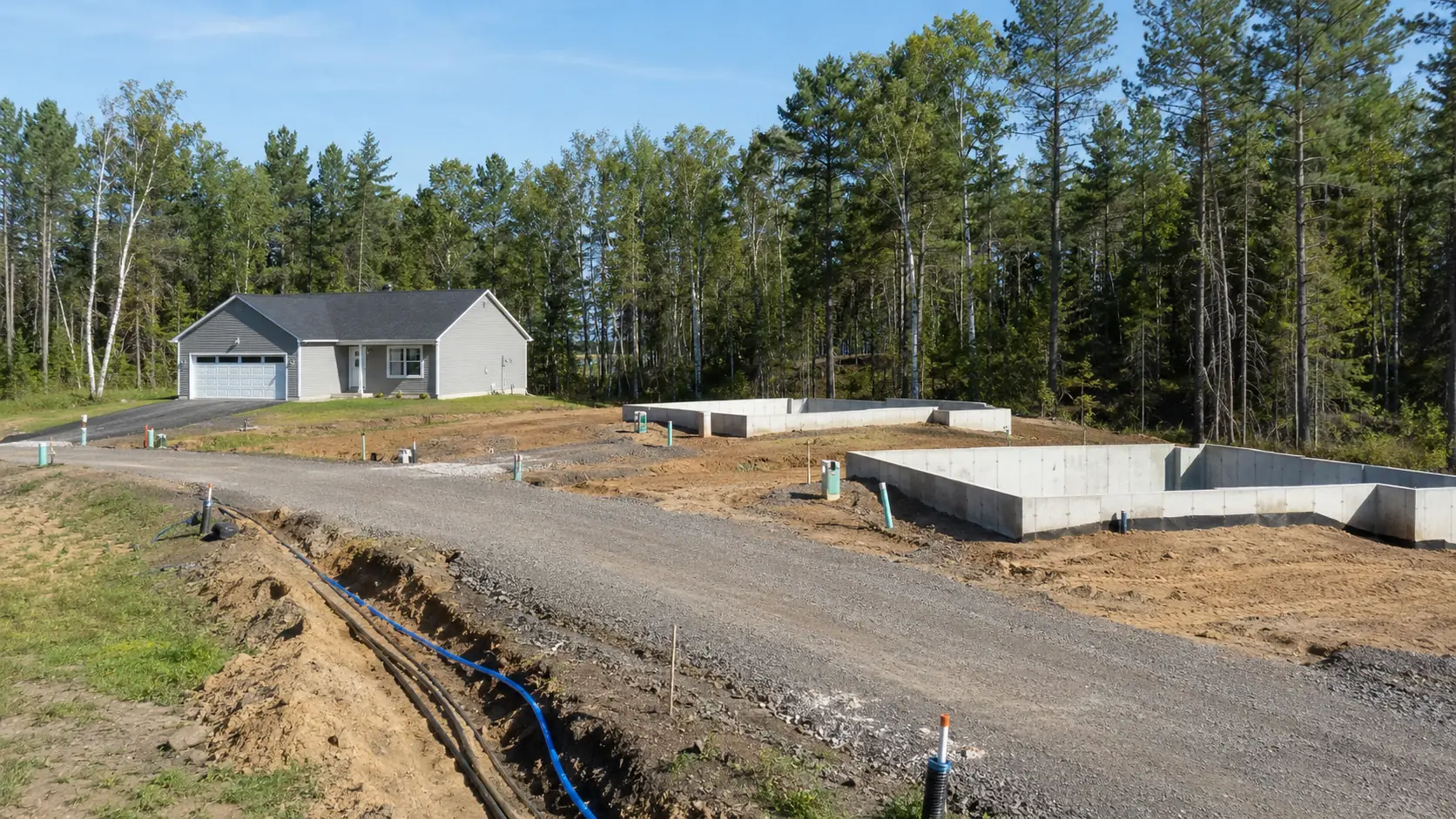
Most housing announcements begin with a rendering of the finished homes. The more consequential work often happens months earlier, when somebody decides who will pay for the road, water, sewer, stormwater and utility extensions beneath them. That is why a Wisconsin Housing and Economic Development Authority meeting scheduled for August 5 deserves attention in the Northwoods.
WHEDA’s published agenda says its Members Loan Committee will consider approval of Infrastructure Access awards in closed session. The committee is also scheduled to take up a separate single-family housing product under Wisconsin Statute 234.665 in open session. The agenda does not identify recipients or disclose the product terms, so it would be premature to claim that a particular Northwoods project will benefit. What it does show is that state housing policy is moving through decisions that directly affect for-sale homes and the land needed to support them.
Infrastructure is the least visible part of a new neighborhood and one of the hardest costs to absorb. A serviced lot can require streets, water distribution, sanitary sewer, stormwater facilities, electric or gas lines, curbs, sidewalks and lighting before the first buyer closes. In a smaller development, those costs are spread across fewer homes. If they are simply added to every lot, an otherwise practical house can land outside the monthly budget of the people the project was intended to serve.
What the numbers leave out
WHEDA’s current single-family Infrastructure Access term sheet is unusually specific about that problem. For the spring 2026 cycle, the program offers subordinate financing for infrastructure supporting new single-family homes for sale. Eligible uses include streets and roads, water systems, sanitary and storm sewers, retention ponds, pump stations, sidewalks, streetlights and utility distribution lines. The listed rate for that application round is zero percent, and the loan is capped at the lesser of eligible infrastructure cost or 33 percent of the total residential development cost.
That does not make the program free money, and it does not rescue a speculative site that is not ready. A developer must have the rest of the project financing in place and must secure necessary permits and approvals. The participating local government must also meet planning requirements and show that it has taken action to reduce project cost through qualifying ordinance or regulatory changes. In practical terms, the state is asking the developer and municipality to arrive with a coordinated project, not merely a general statement that housing would be nice to have.
The affordability rules also shape the finished neighborhood. Under the spring term sheet, buyers of the owner-occupied homes generally must have household income no higher than 140 percent of area median income. Estimated annual housing costs must fit the program formula, and the homes must remain owner-occupied for ten years. During that period, a resale price may increase by no more than five percent per year, compounded annually. Those restrictions deserve careful explanation to buyers because they preserve attainability but also limit short-term appreciation.
Where this gets practical
There is still substantial capacity in the program. WHEDA’s availability tracker, last updated before the spring 2026 application round, showed about $264.3 million of the original $275 million program remaining. It also showed roughly $77.4 million left in the small-community set-aside and about $33.6 million remaining for the North Central regional planning area. The tracker will change as new awards close, but the scale makes clear that the tool is intended to support more than a handful of isolated projects.
That small-community set-aside is especially relevant here. Rhinelander, Merrill, Tomahawk, Eagle River and many surrounding towns operate at a scale where one extension of sewer, one reconstructed street or one group of serviced lots can materially change the local housing pipeline. A program that reduces the carrying cost of that infrastructure can matter more than a modest reduction in the price of the house itself.
Oneida County’s 2025 housing study helps explain the urgency. It estimated a need for as many as 1,358 additional housing units by 2030 and found that people seeking well-maintained homes under $300,000 face especially limited choices. More than 85 percent of survey respondents looking to buy said single-family homes for purchase were the hardest housing type to find. Employer interviews described demand for three-bedroom, two-bath homes and linked the shortage to longer commutes and rejected job offers.
The work in front of us
The study also points toward the same work WHEDA’s program requires: comprehensive planning, subdivision and zoning revisions, developer outreach, public property disposition and stronger state and regional partnerships. In other words, the local research and the state financing tool are aligned. Both assume that housing supply grows when communities prepare buildable sites and make decisions before a developer is carrying land, engineering and interest expense for years.
For a Northwoods municipality, the practical next step is to identify one or two parcels where infrastructure can support a meaningful number of owner-occupied homes. The site should be screened for ownership, zoning, utility capacity, topography, wetlands, access and the likely cost per finished lot. From there, the community and developer can decide whether WHEDA financing changes the math enough to produce homes at the required price and monthly payment.
For a developer, the lesson is equally concrete. The home plan cannot be separated from the civil plan. A compact, efficient house will not create affordability if the road is overbuilt, the utility extension is poorly phased or every lot carries a large share of an undersized first phase. The best application is likely to be the one where the infrastructure scope, home prices, buyer incomes and absorption schedule tell the same story.
The August 5 meeting will not solve the Northwoods housing deficit on its own. Its importance is that the state is putting real financing and product decisions behind the unglamorous work that makes single-family development possible. Once WHEDA publishes the approved awards and final product information, local communities should compare those details against the sites already identified in county studies and comprehensive plans.
Teneleven Development’s interest is straightforward: use tools like these only where they lower the complete cost of durable, owner-occupied homes. The measure of success is not the size of an award. It is whether roads, utilities, land, home plans and financing come together at a price that allows a Northwoods worker or family to buy the finished home and remain there for the long term.