
A new interest-rate sheet does not build a house, but it can change which projects deserve a closer look. USDA Rural Development's Wisconsin office says the base rate for its Section 502 Direct home-loan program is 5.75 percent for loans approved or closed on or after October 1, 2026. For an eligible low- or very-low-income household, payment assistance can reduce the effective rate to as little as 1 percent.
That combination deserves attention in Oneida, Lincoln, Vilas and Forest County because the program can finance more than a house sitting on an already finished lot. USDA says loan proceeds may be used to build, purchase, repair, renovate or relocate a home and to purchase and prepare a site, including water and sewage facilities. In rural Northern Wisconsin, where a well, septic system, driveway and foundation can decide whether a property is affordable, that is an important distinction.
Section 502 Direct is not the same product as a conventional mortgage with a small down payment, and it is not USDA's lender-issued guaranteed loan. USDA is the direct lender. Applicants generally must have income at or below the applicable low-income limit, lack decent, safe and sanitary housing, and be unable to obtain credit on terms they could reasonably be expected to meet elsewhere. The home must be the borrower's primary residence and the property must be in an eligible rural area.
What changed on October 1
The payment assistance is a subsidy tied to household income, not a permanent promise that every borrower will pay 1 percent for the life of the loan. USDA periodically reviews income, and some or all of the subsidy can be subject to recapture when the property is sold, title transfers or the borrower no longer occupies the home. A buyer should understand that future obligation before treating the assisted payment as the whole economic picture.
The program usually requires no down payment, although USDA may require an applicant with assets above specified thresholds to use some of them. Standard direct loans can run as long as 33 years, or 38 years for very-low-income applicants who cannot afford a 33-year term. The longer term can improve the monthly calculation, but it does not erase taxes, insurance, maintenance, utilities or the cost of an overcomplicated site.
The four Northwoods counties share a useful reference point. USDA's area-loan-limit schedule lists a maximum of $324,700 for Forest, Lincoln, Oneida and Vilas counties, effective February 10, 2026. That figure is a ceiling for the program in those counties, not an automatic approval and not a recommended home price. The actual loan is limited by the applicant's repayment ability, the appraised property and other program rules.
The ceiling is not the buyer's budget
A simple payment illustration shows why that distinction matters. At 5.75 percent over 33 years, principal and interest would be about $1,410 per month on $250,000, about $1,692 on $300,000 and about $1,832 at the $324,700 ceiling. These are rounded examples before taxes and insurance, not USDA quotes; an eligible household's payment assistance may reduce its required payment. The right starting number is still the household's complete monthly budget.
The 2025 Oneida County Housing Study puts a local frame around those numbers. It identifies owner-occupied homes priced from $200,000 to $299,000 as a high-priority need for households earning $75,000 to $99,000. More than 85 percent of surveyed home seekers said single-family homes for purchase were the hardest type to find. The USDA ceiling overlaps that target range, but a financing program can help only when an actual finished property is available at a supportable price.
This is where the ability to finance site preparation becomes practical. On a rural homesite, the acquisition price may be only the first line. Soil testing, clearing, grading, driveway construction, a well, septic system, electric service, propane, drainage and foundation work all arrive before the owner has a usable home. Leaving those items outside an early estimate creates a project that appears affordable until the buyer is already committed.
Why the site belongs in the loan plan
A complete USDA-oriented budget should therefore begin with the finished property and work backward. The house, land, delivery, installation, foundation, utilities, permits, professional fees, contingency and closing costs should sit in one worksheet. Every allowance should be tested against a real lot. If the total is too high, the team should know whether the gap comes from the parcel, the home, the financing or the site plan before an application is assembled.
Eligibility also has a map. A mailing address that feels rural is not automatically an eligible address, and an eligible address does not make an applicant or property eligible by itself. USDA provides an address lookup, while its state office and approved loan packagers can help interpret income, repayment and property requirements. Site selection should include that check before option money, engineering or a home deposit becomes difficult to recover.
The property must remain modest, residential and non-income-producing under program standards. That makes Section 502 Direct a homeownership tool, not a way to finance a seasonal cabin, short-term rental or speculative property. Northwoods plans that depend on rental income, oversized acreage or nonresidential uses need a different financing analysis from the beginning.
Factory-built homes need one accountable package
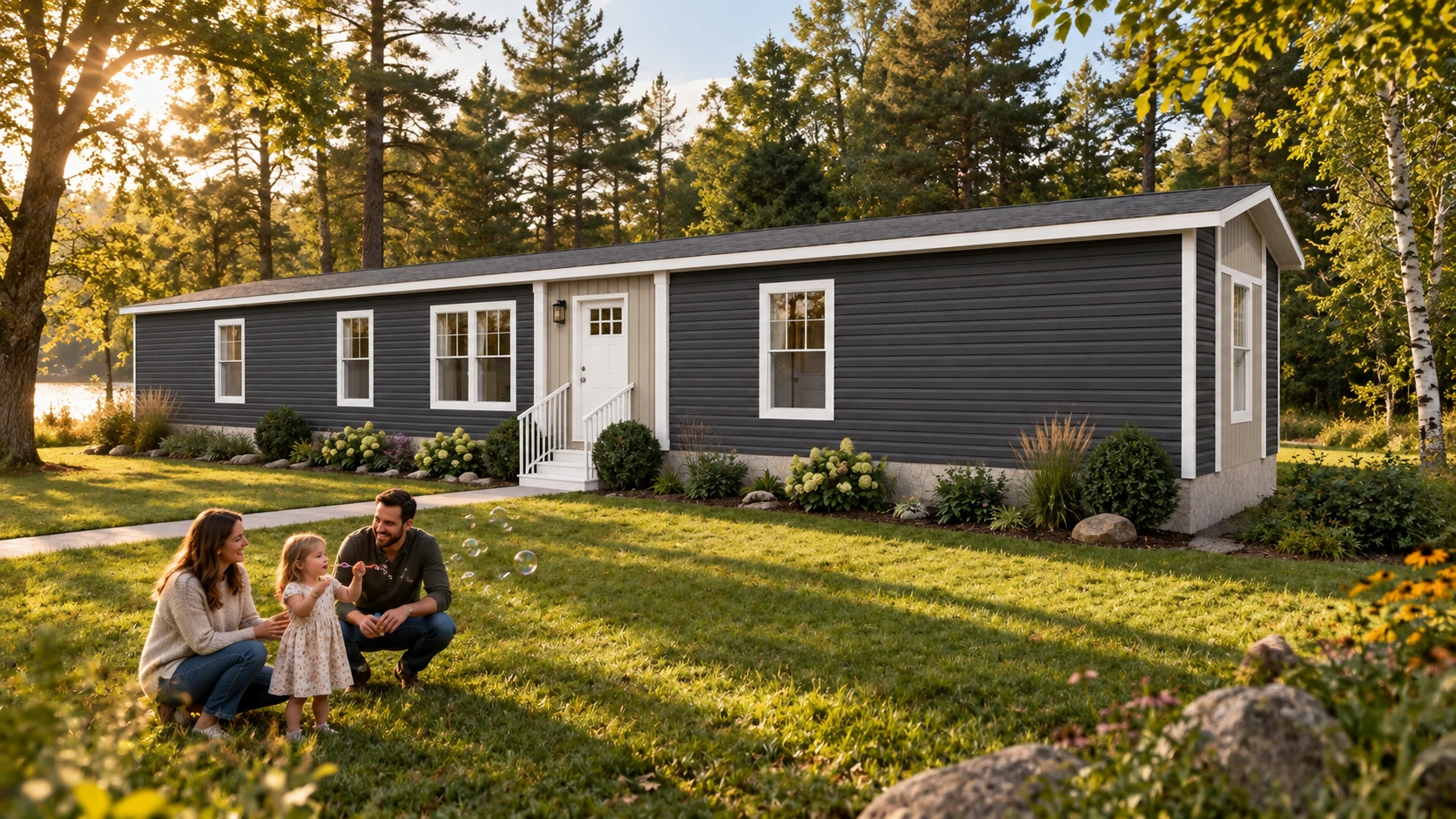
Manufactured homes can be financed through Section 502 Direct, but the program's handbook makes clear that the house and site must be coordinated. For a new manufactured home, the application package includes a plot and site-development plan, a site-specific foundation plan that accounts for conditions such as soil, slope and frost depth, and an itemized total cost covering the home, options, site work, installation and land.
USDA also requires the dealer-contractor to be qualified to place the home on a permanent foundation and develop the site. The handbook calls for one contract covering the unit and site development rather than a stack of separate contracts. That structure is useful beyond compliance: one accountable scope reduces the chance that the excavator, installer, utility contractor and home supplier each assume somebody else priced the missing work.
A new manufactured home's maximum loan term is 30 years rather than 33 or 38. The property also must be appraised before approval, using normal residential appraisal techniques and the best available comparable sales. Where few comparable manufactured homes exist, the appraiser may need to use other homes with appropriate adjustments. That is a reason to involve the lender and appraiser early, not a reason to promise that a particular factory-built model will automatically qualify.
Design the project backward from eligibility
For developers, the most useful response is a small set of repeatable, fully priced homesites. A few plans with known foundations, utility locations and installation scopes can be paired with lots whose access, soils and eligibility have already been screened. The objective is not to design to the maximum loan limit. It is to give an eligible buyer a property whose total cost, appraisal and monthly ownership expense are understandable before construction starts.
Communities and housing partners can help by identifying eligible parcels, reducing avoidable approval delays and directing applicants to USDA or a qualified packager. Those actions do not replace underwriting and should not be presented as guaranteed financing. They make it easier to discover early whether a particular household, home and site can move through the same program successfully.
The October rate creates an opening, not a shortcut. Section 502 Direct can bring the land, well, septic system, foundation and home into one owner-occupied project, while payment assistance can make the monthly obligation more manageable for a qualified household. Teneleven Development's practical interest is in the work that makes that opportunity usable in the Northwoods: buildable land, a complete price, an accountable installation and a home scaled to the buyer rather than the highest number on a loan-limit chart.