
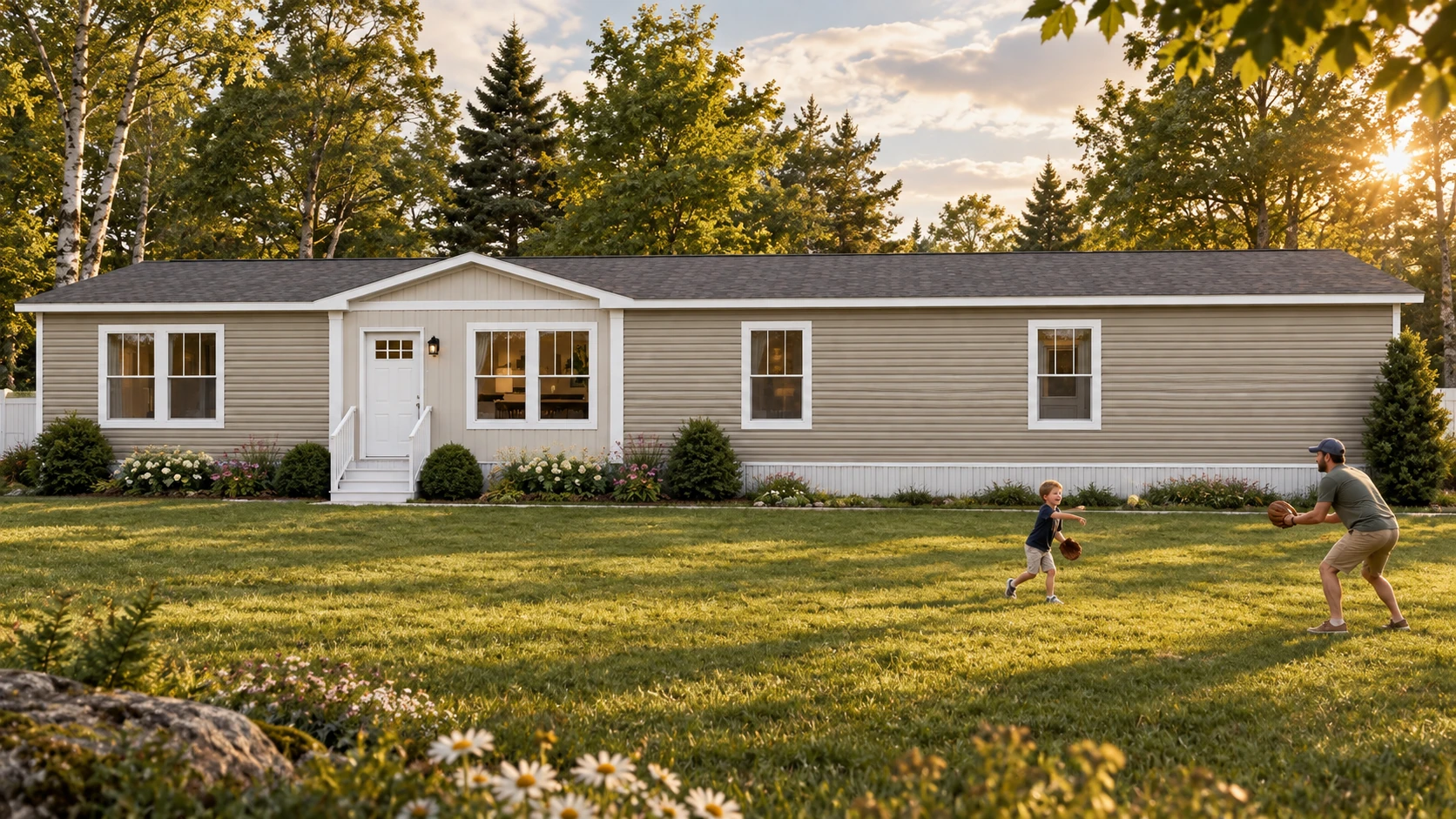
The affordable house is not always the easy house to finance. A Federal Reserve Bank of St. Louis analysis published October 7 puts a national number behind that contradiction: mortgage applications involving manufactured homes had denial rates more than 50 percentage points higher than applications for site-built homes in the public data the researchers studied. Even after accounting for income differences, a gap of five to eight percentage points remained.
That finding matters in Northern Wisconsin because factory-built housing is often presented as a direct answer to the price of new construction. It can reduce and stabilize part of the building cost, but the buyer does not finance a house in isolation. The lender and appraiser must evaluate a completed property: the home, land, foundation, title, access, utilities and market evidence supporting its value.
The St. Louis Fed analysis is national, not a study of Oneida, Lincoln, Vilas or Forest County. It should not be used to predict the outcome of a specific local application. Its explanation, however, fits problems that become more visible in rural markets: few comparable sales, inconsistent property classification and a mortgage system with deeper secondary-market support for conventional site-built homes.
The problem is bigger than the buyer's income
The researchers found that denial rates for site-built homes moved with interest rates, while denial rates for manufactured housing remained persistently elevated across the 2018–2024 period. Their conclusion is that the manufactured-housing barrier is not only the borrower's monthly payment. In many cases, uncertainty about the collateral—the property securing the loan—becomes its own reason to say no.
Comparable sales are one part of that uncertainty. An appraiser working in a subdivision with many recent sales can compare similar homes, lots and locations. On a rural Northwoods road, the nearest recent manufactured-home sale may differ in age, condition, land area, foundation, ownership structure or distance from services. A lower purchase price does not solve the appraiser's problem if there is not enough reliable evidence to support the finished value.
Classification is another part. A manufactured home may be treated as personal property in one transaction and as real estate in another, depending on the land arrangement, title treatment, installation and applicable law. Personal-property loans generally operate outside the conventional mortgage market. That can mean different terms, fewer lenders and less access to the secondary-market channels that provide liquidity for ordinary home mortgages.
A house and a financeable property are not the same thing
This is why permanent installation should be understood as a financing decision as well as a construction decision. A compliant foundation, documented anchoring, completed utilities and coordinated title work help establish what the lender is being asked to finance. They do not guarantee approval, but leaving those questions unresolved until after the home is ordered makes a difficult file harder.
The first practical step is to select the likely financing path before selecting every home option. Standard manufactured-home mortgages, FHA, USDA, WHEDA-supported loans and specialized conventional programs do not all use the same property, borrower or documentation rules. The right sequence is lender, program, home, site and installation plan working together—not a buyer choosing each piece independently and hoping they fit at closing.
Specialized conventional programs show how the market is trying to close the gap. Freddie Mac says homes certified for its CHOICEHome program—also known in the industry as qualifying CrossMod homes—use site-built underwriting and appraisal standards and may be eligible for low-down-payment conventional financing. Fannie Mae's MH Advantage program similarly serves manufactured homes that meet additional design and installation requirements.
Choose the mortgage path before the home
Those names are not blanket approvals for all modern manufactured homes. The specific home must be eligible and properly identified, the site features must meet program requirements, and the borrower and lender must qualify. A plan that looks conventional from the road is not automatically a CHOICEHome or MH Advantage property. Certification and documentation have to follow the actual product and transaction.
The appraisal process also becomes more workable when the file is complete. A useful package can include the purchase contract, manufacturer and model, floor plan, specifications, HUD certification information, foundation design, site plan, utility and driveway scope, permits, installation documents, photographs and a clear breakdown of the complete project cost. The goal is not to tell an independent appraiser what the property is worth. It is to remove avoidable uncertainty about what is being built.
Fannie Mae's lender guidance for MH Advantage illustrates the importance of the comparison method. When fewer than three eligible MH Advantage or CHOICEHome comparable sales are available, the guidance says the appraiser may supplement the analysis with the best appropriate sales, including at least two site-built homes. Freddie Mac likewise maintains specific appraisal requirements for CHOICEHome properties. These are structured alternatives to pretending a rural market has comparable sales that do not exist.
Make the appraisal file easier to understand
For a one-off rural home, that documentation helps one transaction. For a small owner-occupied development, repeatability can help an entire sequence. Several homes built to a known specification, on similar prepared lots, with the same installation approach create clearer cost records and—after sales close—local market evidence. The first property may still be the hardest. Each well-documented closing can make the next appraisal less unfamiliar.
That does not mean every lot or house should be identical. It means controlling the variables that do not create buyer value. A repeatable foundation family, coordinated utility locations, a defined finish package and consistent site documentation can reduce surprises while buyers still choose among suitable plans and options.
The 2025 Oneida County Housing Study explains why this work is worth doing. It identifies owner-occupied homes from $200,000 to $299,000 as a high-priority need and reports that more than 85 percent of surveyed home seekers considered single-family homes for purchase the hardest housing type to find. A lower-cost construction method can help address that shortage only if qualified households can finance the finished property.
Repeatability can create its own evidence
Developers therefore need two feasibility tests. The first is whether the complete project can be delivered at a price connected to local incomes. The second is whether lenders and appraisers can recognize the finished property at that price. Passing the construction test while failing the collateral test still leaves the community without a saleable home.
Municipalities can help without choosing a lender or guaranteeing a buyer. Clear zoning treatment, recorded approvals, predictable permitting and well-documented infrastructure make the real estate easier to describe. Communities can also avoid rules that single out permanent HUD-code homes for restrictions unrelated to health, safety or neighborhood performance.
Buyers can protect themselves by asking direct questions early: Does the lender regularly finance this construction type? Must the home and land be titled together? Which foundation documentation is required? Does the selected model carry the certification needed for a specialized program? How will construction draws, appraisal completion and final installation be handled? An uncertain answer is useful when it arrives before a nonrefundable deposit.
What Northwoods projects can do now
HUD's Next Generation Manufactured Housing Action Plan, also released October 7, recognizes that the next phase of factory-built housing must address more than construction. HUD says its chassis-free case-study work will include zoning, appraisal, lending, insurance and market acceptance alongside design, transportation, foundations and installation. That is an important acknowledgment, but it is a work plan rather than an immediate change to underwriting.
The Northwoods lesson is straightforward. Affordability is not achieved when a factory produces a less expensive house. It is achieved when a local household can buy a permanent home on a buildable lot with a payment and financing structure that will hold together. Teneleven Development's role is to organize that complete property early enough that the home price, site budget, appraisal evidence and loan program are solving the same problem.