
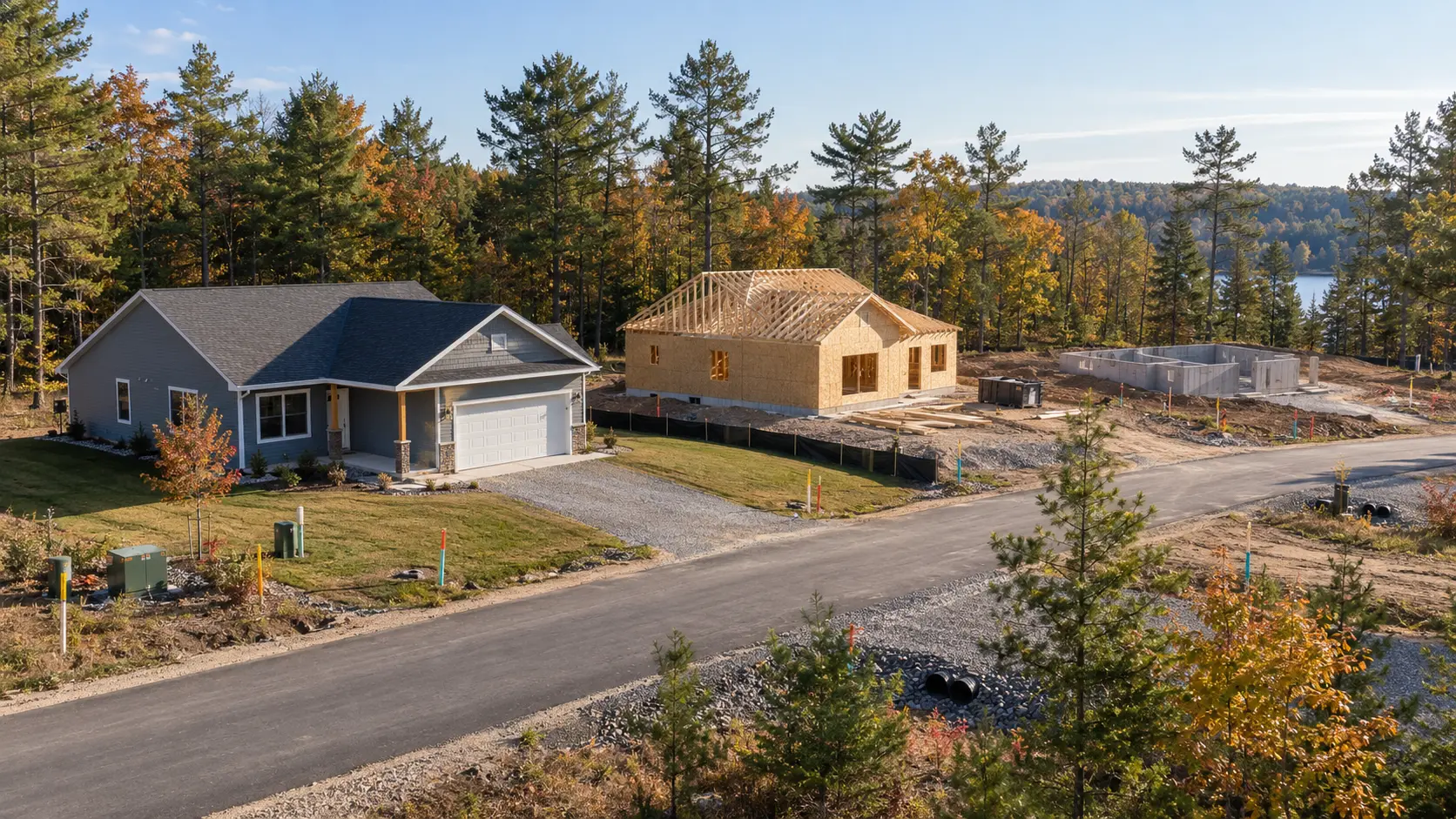
The latest national housing report contains two numbers that pull in opposite directions. The U.S. Census Bureau said on September 17 that single-family housing starts rose to a seasonally adjusted annual rate of 918,000 in August, 7.6 percent above the revised July estimate. Yet permits for future single-family construction fell 1.8 percent to an annual rate of 878,000. One number describes work that began; the other hints at how cautious builders have become about what comes next.
Neither number predicts how many homes will be built in Oneida, Lincoln, Vilas or Forest County. National monthly estimates are volatile, and the Census Bureau publishes a wide uncertainty range around the change in starts. The useful signal is the tension: builders are still producing homes, but the pipeline is being asked to survive expensive financing, higher input costs and buyers with less room in the monthly budget.
That tension became sharper the same day. Freddie Mac reported that the average 30-year fixed mortgage rate reached 6.95 percent on September 17, up from 6.76 percent one week earlier and 6.26 percent a year earlier. The survey is a national benchmark based on thousands of applications, not a promised rate for a particular Northwoods buyer. Freddie Mac describes the benchmark profile as a conventional, owner-occupied, one-unit purchase with good or excellent credit and 20 percent down.
The payment is the development test
At 6.95 percent over 30 years, each additional $10,000 financed is roughly $66 per month in principal and interest. A $20,000 cost difference is about $132 per month; $40,000 is about $265. Those examples do not include taxes, insurance, mortgage insurance, utilities or fees, and an actual borrower may receive a different rate. They simply show why a development decision that adds five figures to every finished lot eventually becomes a household cash-flow decision.
Oneida County's 2025 housing study gives the math a local target. It lists owner-occupied homes priced from $200,000 to $299,000 as a high-priority need for households earning $75,000 to $99,000. More than 85 percent of surveyed home seekers said single-family homes for purchase were the hardest housing type to find, and the study estimates that the county may need as many as 1,358 additional housing units by 2030.
A higher mortgage rate does not erase that demand. It changes the product the demand can reach. When buyers cannot simply stretch another $20,000 or $40,000, the land, street, utilities, foundation and home plan have to work together more efficiently. The saved dollar is valuable wherever it comes from, but the finished lot is often where a project either preserves affordability or quietly gives it away.
Why the lot matters more now
Start with the land basis. A low purchase price is not enough if wetlands, poor soils, rock, steep grades, long utility runs or an awkward access point reduce the number of usable lots. The meaningful figure is land cost per buildable home after survey, environmental review, engineering and realistic layout—not the price per acre printed in a listing.
Then test infrastructure per home. A road, water main, sewer extension, stormwater system or electrical run can be reasonable in total and still be unaffordable when divided across too few closings. Compact lots and shorter utility runs can help, but only where snow storage, drainage, parking, setbacks, wells and septic systems still work. Density that exists only on a concept plan will not lower the buyer's payment.
Phase size deserves the same discipline. Opening every lot at once can increase the amount of borrowed infrastructure sitting ahead of sales. Building too few can force the first households to carry an oversized share of fixed costs. A sound phase is large enough to distribute required improvements and small enough to match a realistic Northwoods sales pace. The right number comes from the civil estimate and absorption plan, not a preference for either a grand opening or a tiny pilot.
Build fewer unknowns into every phase
Site certainty is another affordability tool. Zoning, access, wetlands, soil, utility capacity and preliminary stormwater questions should be resolved while the plan can still change. Each unknown carried into construction becomes a contingency, delay or change order. Predictable approvals do not make materials cheaper, but they can reduce the months of interest and professional time that add no room, insulation or durability to the finished home.
The home itself should be selected against that complete site budget. A modest repeatable plan, manufactured home, modular home or conventional build can each work when the foundation, delivery, appraisal and mortgage path are understood. The construction label is less important than whether the same team can price the next home with fewer allowances and fewer surprises than the first.
Builder incentives can help an individual buyer, but they are not a substitute for structural cost control. Reuters reported on September 16 that 38 percent of surveyed builders were cutting prices and 66 percent were using sales incentives as national builder confidence fell to a one-year low. A temporary rate buydown may bridge a difficult market. It cannot permanently correct an expensive lot, a poorly phased street or a site that was never truly buildable.
Choose repeatability over speculation
For Northwoods communities, the practical response is to prepare a small inventory of real sites. Each candidate should have a credible unit count, utility concept, preliminary civil budget, approval schedule and target finished-home price. Public tools such as infrastructure financing or a residential tax incremental district are most useful after that worksheet identifies the specific cost they would reduce.
For developers, the response is to underwrite to the buyer's payment rather than assuming the market will absorb every increase. That means using current rates, realistic taxes and insurance, conservative appraisal assumptions and a contingency that belongs in the price from the beginning. If the completed home misses the target, the project should show exactly whether land, infrastructure, site work, financing or vertical construction created the gap.
The August starts rebound shows that homes can still move into construction in a difficult market. The decline in permits and the jump in mortgage rates show why the next group cannot be taken for granted. Teneleven Development's objective is to make Northwoods projects more durable under those conditions: buildable land, appropriately phased infrastructure, repeatable homes and a complete cost that remains connected to the people expected to own them.